Every episode, indexed
38 episodes, 247 chapters, 31 hours of tape. Search titles, guests, chapters and show notes.

Who's Funding the $11 Trillion AI Buildout?
H100 rental prices went up, on a GPU that should be sliding down its depreciation curve. That curve is what lenders underwrite. Daniel Nishball (@dnishball) kicks off our new Compute Capital Markets group by following the money through Nvidia's $497B backstops, ClusterMAX as a credit signal, and whether each token is profitable. Jordan Nanos (@JordanNanos) brings the rental data. AI debt is about to pass auto loans.

$200 Buys $12,000 of Opus Tokens, We Bought Every Plan
Pay Anthropic $200 a month and you can pull $12,000 of Opus 5.5 tokens at API pricing. Max Kan (@maxkan) and Andrew Megalaa bought every plan, OpenAI, Meta, xAI, MiniMax, Moonshot, Z.ai, Cursor, and measured every token type to find the ceiling. The catch isn't subsidy. Anthropic still books 50 to 60% gross margins on these plans, which means the API itself is the price gouge.

Tech DD’s, Performance Projections, Benchmarks, Supply Chain, Investment Thesis (Consulting)| Abhilash Jain, Jordan Nanos
Jordan (@JordanNanos) and Abhilash (@AbhilashJain17) discuss the clients SemiAnalysis consulting serves, custom projects like the inference simulator, how client work turns into research products, neocloud due diligence, and why SLAs decide who gets funded. They also discuss Feynman specs, de-specced memory, and a 20-trillion-parameter OpenAI model.
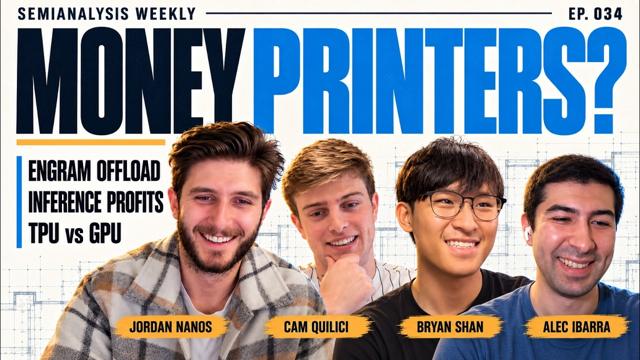
Engrams: How DeepSeek Offloads KV Cache to DRAM and SSD
The InferenceX team is back after two months. Jordan Nanos (@JordanNanos) is joined by Cam Quilici (@noslawextratost), Bryan Shan, and Alec Ibarra to discuss Engram and DRAM offloading, the AgentX benchmark and its profit calculator, TPU v7 on InferenceX, Vera Rubin vs Blackwell, fast tokens, and TileRT on NVIDIA GPUs.

ClusterMAX 3.0 Is Here! Neoclouds Ranked
ClusterMAX 3.0 is here. Sam Harshe (@sharshe02) and Pratt Bhatt (@PrathmeshBhat19) join Jordan Nanos (@jordannanos) after months of testing 77 GPU clouds. Some moved up, some moved down.

300 Datacenter Bans, 3 Projects Delayed: Moratoriums Explained
More than 300 towns, cities, and counties have voted to pause data centers in the past 18 months. Maya Barkin (@mayabarkin) and Reyk Knühtsen (@robotknower) from the SemiAnalysis Data Center, Energy, and Industrials team join Jordan Nanos (@jordannanos) to explain what a moratorium actually is, how they mapped every one of them against the US project pipeline, and why only three projects are being delayed.

EMERGENCY EPISODE: Are We Doomed?
Emergency episode. Doug O'Laughlin (@Fabknowledge) , Joey Brookhart (@SaasquatchC), and Max Kan (@maxkan) join Jordan (@JordanNanos) to talk through Dario's "We Must Pace the Frontier" blog and the responses from Sam Altman and David Sacks. Does pacing actually mean less compute, or a lot more? Plus the Hugging Face incident, Moonshot serving Claude, and the security behaviour that keeps them up at night.

Long Live the Short King: Why 4-HI HBM Wins
NVIDIA previewed Rubin Ultra at 1TB of HBM per package. The part that ships will carry 192GB.

Modular Data Centers Cut Build Time to 12 Months
Traditional data center builds ran 18 to 24 months, sometimes past three years. Modular construction cuts that to 12. Jordan Nanos (@JordanNanos) sits down with Eric Wen, Nigel Chiang, and Nico Bontigui to map what modular actually means, from MEP heavy skids to full containerized builds.

Most Neoclouds Suck At Security: How Agents Hacked Hugging Face
This week Doug, Sam and Jordan discuss the OpenAI vs HuggingFace security incident and our recent article on Neocloud security ahead of ClusterMAX 3.0
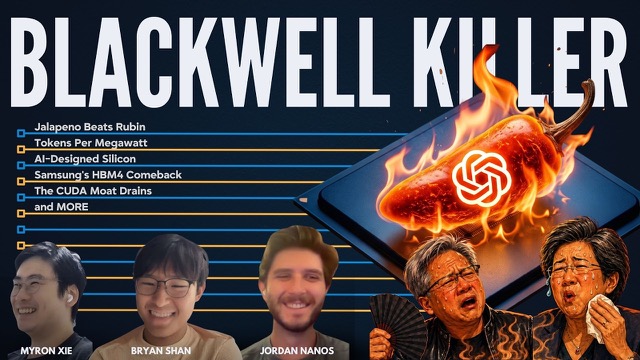
OpenAI Jalapeño: Better Than Nvidia Blackwell
This week Bryan, Myron and Jordan discuss our recent article on OpenAI Jalapeño. They cover the performance, architecture, programming model, implications for NVIDIA and more.1:05 Jalapeno Overview4:22 Tokens Per Megawatt9:15 Benchmark Caveats13:48 The CUDA Moat21:12 How OpenAI Did It32:13 Samsung HBM442:10 AI-Designed Silicon49:24 Architecture Deep Dive56:58 Doom and Wrap

PJM's $12B Modeling Mistake Is Hitting Ratepayers Again
PJM overpaid $12 billion across two capacity auctions, and the same modeling error is set to repeat in an upcoming emergency auction. Robert Boswall (@RobertBoswall) and Jordan Nanos (@JordanNanos) break down how the largest grid in America, 13 states and 66 million people, inflates demand while constraining supply.

DYLAN IS HERE, LIVE!
Dylan joins the pod today, recorded live from our SF office. Jordan and Dylan discuss SemiAnalysis's AI spend, the model that escaped during training, AI rollups eating private equity, new accelerators vs NVIDIA, and whether the pod gives away too much information for free.0:00 Cold Open5:25 SA AI Spend9:29 AI Performance Reviews10:40 AI Rollups13:47 The Agent Moment15:28 The Escaped Model18:11 Model Exponential22:52 Compute and Chips30:18 Open Models32:00 ADHD and AI
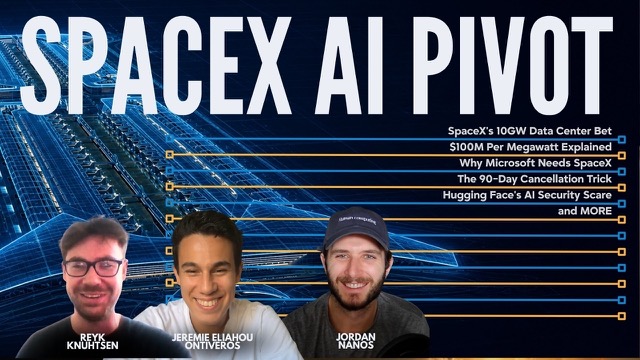
SpaceX's 10GW Plan Drives $300B ARR by 2027
OpenAI and Anthropic are adding close to $30 billion of ARR per month, and the driver is gross margin expansion, not new compute. Jeremie Eliahou Ontiveros (@JeremieEO) and Reyk Knuhtsen (@robotknower) join Jordan Nanos (@JordanNanos) to trace the $100 million per megawatt per year figure from real inference workloads on GB200 and GB300 up through SemiAnalysis simulation. The Google deal prices GB300 capacity near $14 an hour against a $3 average, a premium justified by a 90 day cancellation clause and the ability to turn on megawatts immediately.

Everyone Leaves Google, Elon Forecasts 1T ARR, Reflecting On GPT-5, Building Personalized Software
Jeff Dean and the Gemini leads are leaving Google. Jon Y (@asianometry) makes his FIRST appearance to unpack the exodus with Doug O'Laughlin (@fabknowledge) and Jordan Nanos (@JordanNanos). The crew debates the Demis CEO question, whether Google acquired its innovation or invented it, and how the Bell Labs comparison reads once disruption arrives. First engineers who spent thirty-five years in one job now leaving for passion projects.The episode opens by revisiting the 2024 Dwarkesh clip where Jon questioned whether GPT-5 would be any good. Two years later the verdict is mixed: GPT-5 was a dud, 5.2 was ass, but 5.6 is strong and GPT-6, codenamed Doug, is rumored to write well. Then the Chinese transceiver ban, where the West depends on a supply chain China already owns.

Market Drawdown, Historic Bubbles, Funding The Buildout, AI Politics
Doug is back this week!

The AI Project Trinity: Capital, Offtake, Data Center
AI and datacenter CapEx hits $11 trillion cumulatively from 2024 to 2029, and $7.1 trillion of that needs funding, roughly 75% debt financed. Dan Nishball (@dnishball), Zane Fong (linkedin.com/in/zanefongzq), and Kang Wen Cheang (linkedin.com/in/cheangkangwen) sit with Jordan Nanos (@JordanNanos) to break down the AI project Trinity: capital, offtake, and data centers.
Anthropic vs OpenAI Usage, Margins, Meta Compute, Future of MSL
Coding drives over 70% of lab API revenue, and token austerity policies mostly miss the point. Crystal (@crystalthegg), Max Kan (@maxkan), and Joey Brookhart (@SaasquatchC) break down why blocking teams from Opus saves nothing, while power users at the 99th percentile burn $100k per employee per year. Jordan (@Jordannanos) and the team run break-even math on the Max plans and Anthropic's margins.

Moonshot’s Kimi K3 has Arrived! China has a Frontier Model
A year ago, the big three was OpenAI, Anthropic, and Google. Things have changed.Moonshot's Kimi K3 sits above Gemini on every composite benchmark, and it's open source in 10 days.New episode: what K3 reveals about frontier margins, model sizes, and who's actually still in the game.
Inside the STEEL Lab: From Package to Transistor
SMIC's N+3 node shrank the M0 layer over 15% and cut SRAM area 10 to 20%, all without EUV. SemiAnalysis built a lab just for that; Andrew Wagner and Afzal Ahmad walk Jordan Nanos (@JordanNanos) through the STEEL teardown of Huawei's Kirin 9030, from package to transistor. They explain die shots, FIB and TEM cross sections, NPU discovery, cell height, and standard cell libraries. Then backside power, GAA, and where SMIC goes next.
Stop Saying Half of 2026 US Datacenter Capacity Is Canceled
Bloomberg said half of 2026 US data center capacity is delayed. The SemiAnalysis Data Center, Energy, and Industrials team pulled the underlying report and found a broken denominator. Amazon alone built 4GW in 2025 and is adding 5GW plus in 2026. CoreWeave adds a gigawatt, all under construction. Jeremie Eliahou Ontiveros (@JeremieEO), Reyk Knuhtsen (@robotknower), and Ellie Holbrook join Jordan Nanos (@JordanNanos) as they walk through why the number is wrong and what the real forecast shows.
DeepSeek V4 and Huawei Ascend NPU Performance
DeepSeek V4 claims a 100x KVcache reduction versus a standard MoE model, hitting 1M context length through compressed sparse attention and heavily compressed attention. Kimbo (@Kimbochen), Cam Quilici (@noslawextratost), Bryan Shan join Jordan Nanos (@JordanNanos) to break down what changed from V3, why the new MHC dimension tripped up NVIDIA on day zero, and how Mega MoE fuses compute and communication into a single kernel.

What Unitree's Evolution Means For Robotics

DG Matrix Explains 800V DC vs Legacy AC Distribution
NVIDIA's next architecture will demand 800V DC and datacenters can't wait to build the infrastructure. Haroon Inam, CEO and Co-Founder of DG Matrix, joins Jordan Nanos (@JordanNanos), Jeremie Eliahou Ontiveros (@JeremieEO), and Nicolas Bontigui to explain why megawatt GPU racks make 800V DC a necessity, not an option. Haroon details his journey from uncool power electronics to enabling superhuman intelligence infrastructure.

Finding Miscompiles For Fun, Not Profit
Justin Lebar (jlebar.com) recently spent $10,000 in an afternoon, uncovering critical miscompiles across NVIDIA's PTXAS, LLVM's AMD GPU, and X86 backends. He joins Jordan Nanos (@JordanNanos) to detail his methodology, which combined traditional fuzzing techniques with novel LLM-assisted bug finding. Their discussion highlights the unique challenges of detecting flaws in less-tested ML compilers compared to mature CPU environments.Lebar shares specific high-severity X86 findings, including an atomic operation bug that splits into two non-atomic operations. They explore the comparative efficacy of fuzzing versus LLM agents in identifying these elusive errors. This episode offers critical insights into compiler security and the burgeoning role of AI in automating rigorous code verification for AI infrastructure.FULL ARTICLE
AWS Margins Jump 10% While Azure and GCP Flatline
AWS operating margins jumped 10 percentage points while Microsoft Azure and Google Cloud stayed flat. The driver: Anthropic's Claude usage routing through Bedrock, Amazon's token-as-a-service platform.
Cerebras IPO: 1,100 Tokens Per Second vs GPU's 500
Jordan Nanos (@JordanNanos), Howie, and Myron Xie break down the economics of Cerebras's IPO on the eve of their public debut, examining their OpenAI and Amazon deals that have shifted the company away from Middle Eastern investor concentration toward frontier AI labs willing to pay exponentially more for speed.The discussion covers Cerebras's radical stitching innovation across a full wafer, creating compute density equivalent to an entire NVL72 rack without off-chip data movement. The hosts analyze whether businesses will accept these premium economics as fast tokens become the new standard for interactive AI applications.Subscribe for weekly deep dives into semiconductor economics and AI infrastructure developments.

GPT 5.5 vs Claude 4.7: OpenAI's Comeback From the Brink
OpenAI was in serious trouble at the beginning of this year. Anthropic's Claude Opus 4.5 release had triggered a wave of developers to start using Claude Code, pushing Anthropic's revenue past OpenAI's on a like-for-like basis by April. OpenAI's GPT 5.4 response was such an embarrassment they didn't even compare it to Claude in their model release card. Then came GPT 5.5 - finally back on the frontier, but is it enough to reclaim the crown?

How Much Do GPUs Really Cost, and Where Does the Value Go?
This episode features Jordan Nanos (@JordanNanos) and Daniel Nishball (@dnishball) breaking down the economics of GPU clusters through real-world data and experience. Joined with Kang Wen Cheang and Zane Fong, the team discussed moving beyond theoretical TCO models as they examine how reliability differences between top-tier and lower-tier providers create significant cost disparities that aren't captured in simple per-GPU pricing. The discussion introduces practical frameworks for measuring goodput and understanding how system failures cascade through entire training jobs.Nanos walks through the mechanics of fault-tolerant frameworks including AWS's Checkpointless Training and explains why a single GPU failure can halt progress across hundreds of nodes. The conversation reveals how hyperscalers and NeoClouds price their services and why paying premium rates for reliable infrastructure often delivers better value than chasing the lowest per-hour costs. Subscribe to SemiAnalysis for in-depth analysis of AI hardware economics and infrastructure trends that impact the entire semiconductor ecosystem.

Using Open Source Data To Drive Investment Decisions
This week the team from ChipBook (formerly Chips & Wafers) joins. Jordan Nanos talks with Chaim Eisenberg and Simi Sherman as they explore how they build the ChipBook with open source data, and how that drives investment decisions. This episode dives deep into the ChipBook itself, revealing how granular, historical data collection provides insights into supply chain dynamics, memory markets, wafer fabrication equipment trends and more. The guests also share compelling examples of how their data-driven approach has generated some viral social media recently.for more: SemiAnalysis.com/chipbook00:00 The Chipbook: Understanding Open Source Data07:56 Granularity in Data: The Key to Investment Insights09:11 Understanding the Semiconductor Supply Chain10:52 Memory Market Insights and Trends14:23 Tracking WFE and Its Impact on Production15:20 The Importance of Early Signals in Investment16:51 Geopolitical Implications on Semiconductor Supply20:24 The Impact of Tariffs and Regulations22:48 Granular Tracking for Investment Decisions27:07 Data-Driven Insights and Investment Strategies29:13 The Structure of the Chipbook33:02 Collaboration and Integration at Semi Analysis37:02 Geopolitical Analysis and Its Impact on TSMC43:48 Helium Supply Chain and Its Importance

Claude Code Psychosis: How SemiAnalysis Is Token Mogging Meta
Jordan Nanos (@jordannanos) Daniel Nishball (@dnishball) and Sam Harshe (@sharshe02) break down how SemiAnalysis is deploying Claude Code agents across its Singapore office at a scale that outpaces Meta on a per-employee basis. They cover the practical workflow changes, the trust and reliability questions that come with AI-generated analysis, and what it actually takes to build an agent swarm that does useful work. The conversation also gets into cybersecurity risks and where AI model development is headed next.00:00 - Introduction and Team Dynamics09:10 - The Evolution of Agent Utilization14:49 - Conference Insights and Research Efficiency15:58 - AI's Role in Learning and Analysis21:13 - Trust and Reliability in AI Outputs27:04 - Market Impact and Adoption of AI Tools32:14 - Cybersecurity and AI: Opportunities and Challenges39:32 - Future of AI Models and User Experience
The 3 Choke Points Killing the AI Boom
The Core Research team is on SemiAnalysis Weekly this week. Jordan Nanos, Nick Doyle, Nigel Chiang, and Konrad Wang walk through the biggest bottlenecks in AI infrastructure: TSMC capacity constraints, PCB and substrate shortages, memory cycle dynamics, modular data center construction, and behind-the-meter power. The team also gets into how Claude Code is transforming their day-to-day research, what enterprise AI adoption actually looks like today, and the signals they're watching for when the cycle turns.
The AI Silicon Shortage Explained
This week, Sravan Kundojjala (@SKundojjala) and Ivan Chiam ( from our team join Jordan (@JordanNanos) to break down the AI silicon shortage — and why its ripple effects are hitting everything from GPU pricing to your next smartphone.We cover what's driving the crisis, how TSMC is allocating scarce capacity across its biggest customers, and why memory constraints could cut consumer electronics production by 10–15%. We dig into TSMC's $70B+ capex plans, the structural dynamics reshaping the memory market, and near-term node migration strategies that could offer some relief. Then we shift to the GPU rental market, tracking real pricing trends and what they signal about supply and demand heading into the back half of the year.In the second half, we unpack Nvidia's co-packaged optics (CPO) roadmap — one of the most significant infrastructure announcements to come out of recent industry events. We cover highlights from the OFC conference, explain why optical interconnects matter for next-gen AI clusters, and break down the dueling MSA standards battle playing out across the optical components industry.Whether you're an investor, engineer, or just trying to understand why AI hardware is so hard to get right now — this one's for you.
Measuring AI's Impact On The Market
This episode explores the impact of AI on memory costs, market dynamics, and economic measurement. Our experts discuss how AI is transforming industries, the challenges of measuring economic value, and the future of AI adoption across sectors. This week Jordan hosts Ray Wang, Malcolm Splitter, Joey Brookhart from SemiAnalysis.
The Impact of AI Datacenters On Consumer Power Costs
Join Jordan Nanos, Doug O’Laughlin, and special guest Jeremie Eliahou Ontiveros for an in-depth analysis of the intersection between AI infrastructure and energy markets. Jeremie, Head of Datacenter & Energy Infrastructure Research, shares expert insights on how AI data centers are reshaping electricity pricing, market dynamics, and the regulatory challenges facing the grid today.